Inicio > Sociedad y ciencias sociales > Sociedad y cultura: general > Europe’s Vulnerabilities in Modern Conflict
Europe’s Vulnerabilities in Modern Conflict

Europe’s Vulnerabilities in Modern Conflict

Artur Victoria

11,76 €
IVA incluido
Disponible
Editorial:
Artur Victoria
Año de edición:
2025
Materia
Sociedad y cultura: general
ISBN:
9798232307363
11,76 €
IVA incluido
Disponible
Añadir a favoritos

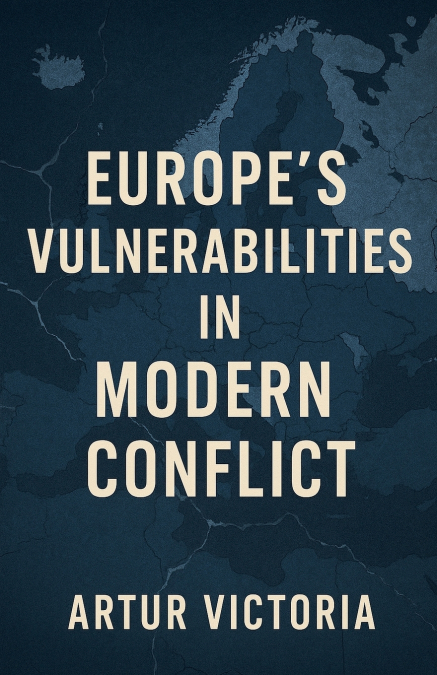
Europe stands at a crossroads in its geopolitical evolution, facing a spectrum of security threats that span the traditional and the novel, the visible and the covert. For decades, the continent benefited from a relatively stable security environment under the protective umbrella of multilateral institutions and international norms. This stability, however, created structural weaknesses: defence budgets stayed low, critical infrastructure aged without adequate protection, and the urgency to modernise military capabilities waned. The result is a Europe that is economically powerful but strategically fragile-a continent whose institutions were built for peace yet must suddenly contend with a world slipping back into great‑power rivalry, asymmetric conflict, and technological disruption.The vulnerabilities Europe faces today are not confined to a single domain. Conventional military threats have resurfaced in ways many policymakers once believed impossible after the Cold War. Terrorism, though less dominant in headlines, remains a persistent and decentralised danger that exploits social fragmentation and gaps in intelligence coordination. Hybrid warfare-deliberate ambiguity, disinformation, economic coercion, and covert action-targets the political cohesion that the European Union relies on. Cyber warfare, meanwhile, cuts across every modern system, from energy grids and financial institutions to hospitals and government services, exposing uncomfortable interdependencies and inconsistent standards of protection.These challenges are not occurring in isolation. They interact and amplify one another. A cyberattack on energy networks can destabilise a country’s political environment, creating opportunities for external actors to launch disinformation campaigns. A terrorist incident can inflame polarisation, weaken trust in institutions, and make it easier for hostile states to spread influence operations. A conventional military threat can be paired with hybrid tactics designed to slow European decision‑making, undermine solidarity, and fracture alliances. Modern conflict is not neatly compartmentalised; it is fluid, blended, and strategically synchronised. Europe must therefore confront not only individual threats but also the combined effect of multidimensional pressure.
Artículos relacionados

  • The Gandhian Iceberg
    Chris D Moore-Backman
    The Gandhian Iceberg presents a bold, new interpretation of Gandhian nonviolence from the rare perspective of an author who is equal parts writer, scholar, and frontlines practitioner. The book faces the current crisis of climate change and the intensification of social unrest around the world, and calls for a new convergence of serious, spiritually-rooted US nonviolence activi...
    Disponible

    11,52 €

  • Contemporary Developments in Child Protection
    Nigel Parton
    Volume 1 "Policy Changes and Challenges" takes as its central theme the ongoing and challenging issues which child protection agencies have to address and the policy and practice initiatives that are developed to try and address these. The volume includes papers on: the relationship between the decline in the rate of ‘unnatural’ deaths and the growth of concern about child abus...
    Disponible

    58,76 €

  • Bal Gita
    Ram Roop
    Bal Gita provides condensed learning from the well known book Gita. It teacheshumanity, your bound duties, how to respectfully interact with other people, and the deeds of practicing Good Karma. The Author passes on his version of learning from Ram Roop was born in Lautoka Fiji Islands, and moved to Surrey Canadaearly 1970. Whilst well versed in Hindu scriptures throughout his ...
  • Being 2.0
    Razique Mahroua / Paloma Vita
    To which degree does said culture define oneself and one’s choices? Can one shed the layers of cultural conditioning past the thickness education creates?Being 2.0 aims to reflect on such questions and offer the reader a transpersonal experience fed by an in-depth work of deconstruction. Being 2.0 is the retelling of the author’s story, son of immigrants who moved from Algeria ...
  • Diversity in Information Technology Education
    Goran Trajkovski
    ...
    Disponible

    112,14 €

  • Model-Driven Software Development
    Model-driven software development (MDSD) drastically alters the software development process, characterized by a high degree of innovation and productivity. However, quality assurance application in the domain of software models and model-driven software development is still in an emergent phase. Model-Driven Software Development: Integrating Quality Assurance provides in-depth...
    Disponible

    256,53 €

Otros libros del autor

  • The Hidden Vulnerability - How Judicial Backlog Threatens National Defence
    Artur Victoria
    From a national defence perspective, judicial delays are not merely a social or economic problem; they can also pose a significant national security threat. National security is defined not only by military strength and external defence mechanisms but also by the internal stability of a country. A judicial system that fails to deliver justice in a timely manner is one of the mo...
    Disponible

    14,03 €

  • Invisible Battlefield
    Artur Victoria
    Systemic Destabilisation Warfare (SDW) presents a ground-breaking redefinition of modern conflict, arguing that twenty-first-century warfare has migrated from physical battlefields into the cognitive, informational, institutional, and emotional infrastructures of society. Drawing on interdisciplinary research across geopolitics, psychology, security studies, and systems theory,...
    Disponible

    14,86 €

  • Mouldering The Imaginary
    Artur Victoria
    For most of human history, the self was a largely private construction - formed through personal experience, community interaction, and cultural norms. Identity evolved slowly, shaped by family, environment, class, religion, and circumstance. While people performed various social roles - as parents, workers, citizens, friends - the idea of performing constantly, publicly, and ...
    Disponible

    9,70 €

  • The Myth of Peace
    Artur Victoria
    Conflict once had a recognizable form. It marched beneath flags, crossed borders, occupied cities, and left its scars upon the earth. War began with declarations and ended with treaties. Peace was simply the interval between these moments-a period defined by order and the absence of violence. This pattern became so familiar that it solidified into assumption: war was exceptiona...
    Disponible

    17,47 €

  • Toxic Ties - How Destructive Politics, Workplaces and Relationships Shape Our Lives
    Artur Victoria
    The word has become cultural shorthand - toxic politics, toxic workplaces, toxic friendships, toxic social media - but the widespread use of the term is more than just a linguistic fad. It signals a collective recognition that something is deeply wrong with the relationships that shape both our private lives and our public systems.At first glance, these forms of toxicity may s...
    Disponible

    18,25 €

  • China Geopolitics
    Artur Victoria
    China is determined to innovate and open up in order to explore new ideas, new models and new paths for international development cooperation, drawing on the successful experience of other countries and international organisations, actively participating in multilateral development cooperation.Through its joint work with the international community, it participates in the imple...
    Disponible

    21,90 €