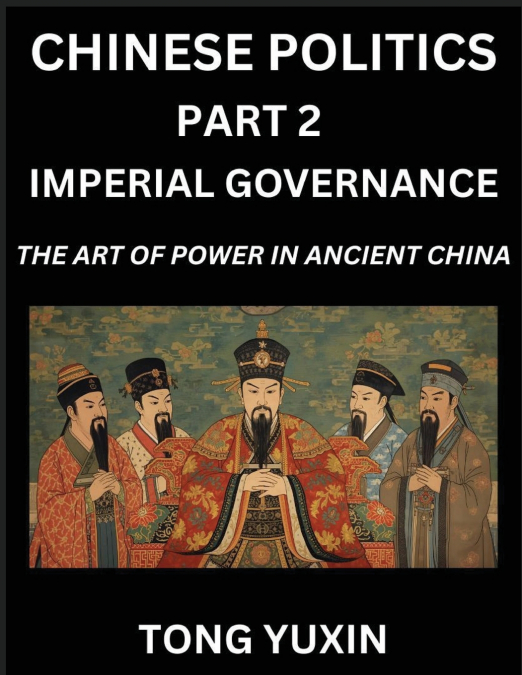
Inicio > Humanidades > Historia > Historia regional y nacional > Historia de Asia > Chinese Politics (Part 2)- Imperial Governance, The Art of Power in Ancient China, The Mandate of Heaven, Government, Statecraft and Authority in Imperial China, Strategies and Secrets of Ancient Chin
Chinese Politics (Part 2)- Imperial Governance, The Art of Power in Ancient China, The Mandate of Heaven, Government, Statecraft and Authority in Imperial China, Strategies and Secrets of Ancient Chin

Chinese Politics (Part 2)- Imperial Governance, The Art of Power in Ancient China, The Mandate of Heaven, Government, Statecraft and Authority in Imperial China, Strategies and Secrets of Ancient Chin

Yuxin Tong

64,94 €
IVA incluido
Disponible
Editorial:
Chinese Politics
Año de edición:
2025
Materia
Historia de Asia
ISBN:
9798895843239
64,94 €
IVA incluido
Disponible
Añadir a favoritos

For centuries, the governance of ancient China was far more than a system of rules-it was a living philosophy, a dance between heaven and earth, where emperors sought not just to rule but to embody cosmic order. The concept of 天命 (tiānmìng, 'Mandate of Heaven') was more than a claim to power; it was a moral contract, a promise that the ruler’s authority depended on their virtue and wisdom. This book delves into the heart of 'Imperial Governance', revealing how rulers, ministers, and scholars wove ethics, strategy, and ritual into the fabric of daily rule.At its foundation lay 德 (dé, 'virtue') and 礼 (lǐ, 'ritual')-principles that governed everything from court ceremonies to tax policies. The 'Art of Power' was not about brute force but about persuasion, about making the people believe in the emperor’s divine right to lead. Yet beneath this idealism lay a world of 权谋 (quánmóu, 'strategic maneuvering'), where emperors balanced alliances, suppressed rebellions, and outmaneuvered rivals to survive.This work traces the evolution of governance across dynasties: the 周 (Zhōu) Dynasty’s feudal order, where local lords held power under heaven’s gaze; the 秦 (Qín) Empire’s legalist revolution, which centralized authority with an iron fist; and the 唐 (Táng) Dynasty’s golden age, where bureaucracy and cosmopolitanism flourished. Along the way, we see how 科举 (kējǔ, 'imperial examinations') transformed China’s elite, turning scholars into statesmen and reshaping the very nature of power.But governance was never static. The tension between 中央 (zhōngyāng, 'central') control and 地方 (dìfāng, 'local') autonomy echoed through every decree, every rebellion, every reform. Some emperors ruled with 仁政 (rénzhèng, 'benevolence'), winning loyalty through fairness; others relied on fear, only to see their dynasties crumble.This is not a story of simple 'autocracy.' It is a tale of innovation-of how rulers adapted to crises, borrowed ideas from rivals, and reinvented governance to suit their times. Whether through the 法家 (Fǎjiā, 'Legalist') harshness of the Qín or the 儒家 (Rújiā, 'Confucian') flexibility of the Song, the art of power in ancient China was always evolving, always contested. And in its lessons, we find echoes of modern struggles over authority, legitimacy, and the limits of rule.
Artículos relacionados

  • Understanding Aikido
    Jan J Sunderlin
    Understanding Aikido: Essential Information and Perceptions (Special Edition) presents an historical, cultural, and philosophical look at the development of the Japanese martial art of Aikido. Sunderlin focuses on the influences brought to bear on Morihei Ueshiba, the founder of Aikido, and the subsequent cultivation of the latter's martial art as a vessel of Budo. The author a...
    Disponible

    63,06 €

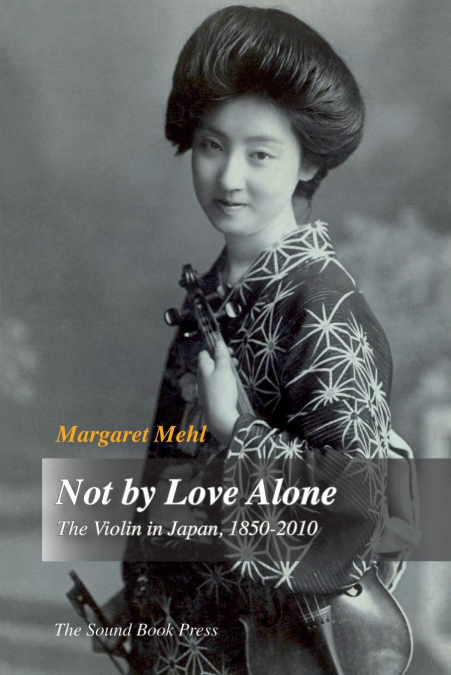
  • Not by Love Alone
    Margaret Mehl
    Suzuki Shin'ichi, the Tokyo String Quartet, Midori - How did Japanese violinists manage to revolutionize violin teaching, win international competitions, conquer Western concert stages, study at world-famous conservatoires and take up positions in leading orchestras and prestigious music faculties? What enabled the Japanese to master Western classical music within a few decades...
    Disponible

    29,32 €

  • Pictures in Transformation
    Luca Maria Olivieri
    ...
    Disponible

    54,79 €

  • Life and Death in the Korean Bronze Age (c. 1500-400 BC)
    Sunwoo Kim
    This research focuses on the Bronze Age in selected areas of Korea; Seoul, Incheon, and Gyeonggi province. Two forms of evidence - settlements and monuments - are taken into account to identify their relationship with landscape and the social changes occurring between ca. 1500 to 400 cal BC. Life and death in the Bronze Age in Korea has not been synthetically investigated befor...
    Disponible

    108,34 €

  • South Asian Archaeology 2007
    Proceedings of the 19th Meeting of the European Association of South Asian Archaeology in Ravenna, Italy, July 2007.                     ...
    Disponible

    182,04 €

  • CHINA THROUGH AMERICAN EYES
    Wenxian Zhang / ZHANG WENXIAN
    Cultural understanding between the United States and China has been a long and complex process. The period from the mid-nineteenth century to the early twentieth century is not only a critical era in modern Chinese history, but also the peak time of illustrated news reporting in the United States. Besides images from newspapers and journals, this collection also contains pictur...
    Disponible

    159,39 €

Otros libros del autor