Michael Webster
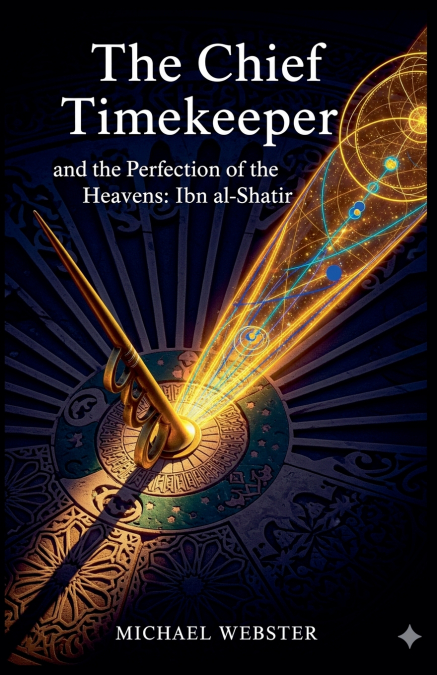
The year is 1365. In the thriving Mamluk capital of Damascus, the Chief Muwaqqit (master timekeeper) of the Umayyad Mosque, Ibn al-Shatir, completes his life’s work: a meticulous, geometrically flawless model of the cosmos. For centuries, astronomers had struggled with the glaring philosophical flaw in Ptolemy’s geocentric universe, a mathematical inconsistency known as the equant. Ibn al-Shatir finally dismantled the entire apparatus, perfecting the two-thousand-year-old classical tradition with a revolutionary, equant-free system built entirely on pure circular motion.Two centuries later, Nicolaus Copernicus publishes his heliocentric theory, launching the Scientific Revolution-and he uses the exact same geometric mechanisms invented by Ibn al-Shatir.The Chief Timekeeper and the Perfection of the Heavens explores the remarkable life of this fourteenth-century polymath, tracing his mastery of observation and instrument making within the powerful Damascus School. It delves into the rich cultural landscape that sustained advanced Islamic science and confronts one of history’s greatest mysteries: Was the Islamic world a crucial, unacknowledged precursor to the Copernican revolution?Discover the true architect of the ultimate classical universe and the forgotten geometry that may have changed the course of global science. Approx.178 pages, 33700 word count