Inicio > Humanidades > Filosofía > Sobre la mecánica consciente III
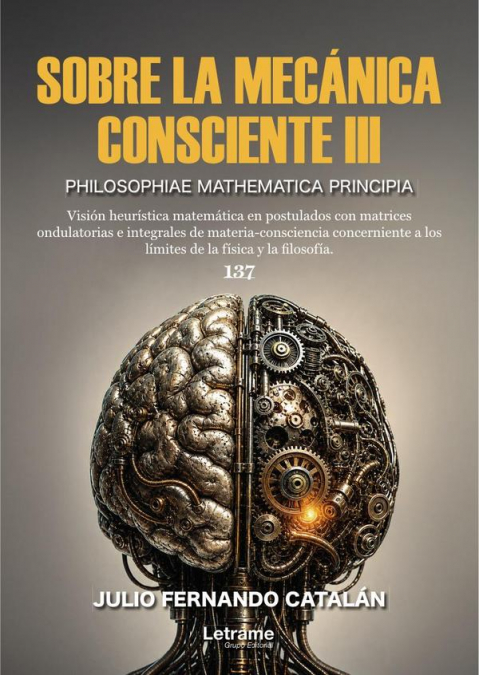
Sobre la mecánica consciente III

Sobre la mecánica consciente III

Julio Fernando Catalán

19,66 €
IVA incluido
Disponible
Editorial:
Letrame
Año de edición:
2026
Materia
Filosofía
ISBN:
9791370299903
19,66 €
IVA incluido
Disponible
Añadir a favoritos

Sea la pregunta filosófica y física angular, ¿por qué hay algo en vez de nada?, y este “algo” depende del valor exacto de algunos números o constantes llamadas universales. Se han conjeturado diferentes respuestas: Del diseño inteligente, plantea la existencia de un dios o creador que ha calculado el valor propio de cada constante para hacer posible un universo con materia inteligente. De los multiversos, basado en el principio antrópico, existen infinitos universos con diferentes valores de dichas constantes, el nuestro corresponde a los calculados porque si fueran otros no estaríamos aquí. De la necesidad de unas matemáticas ocultas todavía no conocidas, sobre este último punto trata la presente obra. “… encontrar una teoría puramente algebraica para la descripción de la realidad. Pero nadie sabe cómo obtener la base de una teoría semejante”. Albert Einstein. “Todo lo que hay en el universo físico está gobernado por principios matemáticos, quizá por algunas matemáticas diferentes. Tal vez surja una teoría final en cuyos términos pueda entenderse lo que llamamos realidad. Si es así, la naturaleza de dicha teoría debe diferir enormemente de lo que hasta ahora hemos visto. Tendría que haber una simplicidad profundamente subyacente en dicho punto. Podemos preguntar qué tipo de matemáticas son las que encuentran un papel profundo, quizá los factores cruciales subyacentes que gobiernan la relación misteriosa entre matemáticas y física serán mejor entendidos en alguna fecha futura, lo que necesitamos fundamentalmente es algún cambio sutil de perspectiva…algo que todos hemos pasado por alto…”. Roger Penrose. Ser o no ser. En ese orden. La Filosofía siempre hizo las mayores preguntas. ¿La mejor respuesta?, la de una calavera. Solo Dios podría crear un universo que no necesite de Dios. Lo más cercano que estuve de la muerte es exactamente este mismo instante, igual que usted.

Artículos relacionados

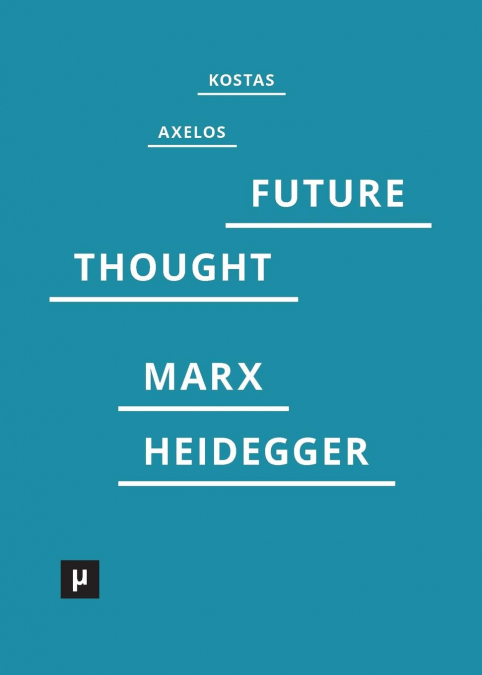
  • Introduction to a Future Way of Thought
    Kostas Axelos / Kenneth Mills
    'Technologists only change the world in various ways in generalized indifference; the point is to think the world and interpret the changes in its unfathomability, to perceive and experience the difference binding being to the nothing.'Anticipating the age of planetary technology Kostas Axelos, a Greek-French philosopher, approaches the technological question in this book, firs...
    Disponible

    18,58 €

  • Capsule
    John Kenneth Press
    Join John and Adam as they wander the mean streets of Japan on a psychedelic fueled search for identity. While fun for the average reader, this book could also serve as a philosphy textbook because of its ordered exploration of sources of identity. Ultimately this trip through nationalist attacks, sex, and drugs, will take you to a better understanding of yourself and your pl...
    Disponible

    11,51 €

  • If you look at it long enough...
    Paul Hallam
    Originally written for an academic journal, If you look at it long enough... is primarily a personal account of Paul Hallam’s recollections of “self-abuse” through the consumption of porn over several decades. Challenging the familiar form of an “academic essay,” this autobiographical narrative raises several questions in relation to our contemporary morals related to sex in ge...
    Disponible

    11,30 €

  • The Teachers of Gurdjieff
    Rafael Lafort / Rafael Lefort
    When The Teachers of Gurdjieff was first published more than 50 years ago, it made a considerable stir. George Ivanovich Gurdjieff had been one of the most famous mystics in the West in the first half of the 20th century - a teaching master who had many fashionable and influential pupils. He had a striking appearance and manner of teaching, and his teaching proved to be very in...
    Disponible

    20,45 €

  • Manifesto of the Communist Party
    Karl Marx
    The Communist Manifesto was first published on February 21, and it is one of the world’s most influential political tracts. Commissioned by the Communist League and written by communist theorists Karl Marx and Friedrich Engels, it laid out the League’s purposes and program. The Manifesto suggested a course of action for a proletarian (working class) revolution to overthrow the ...
  • The Art of Literature
    Arthur Schopenhauer
    Collected here are eight short essays, On Authorship, On Style, On the Study of Latin, On Men of Learning, On Thinking for Ones Self, On Criticism, On Reputation, On Genius, by the world renowned philosopher Arthur Achopenhauer. ...