Inicio > Derecho > Derecho internacional > International practical guide to collaborative law
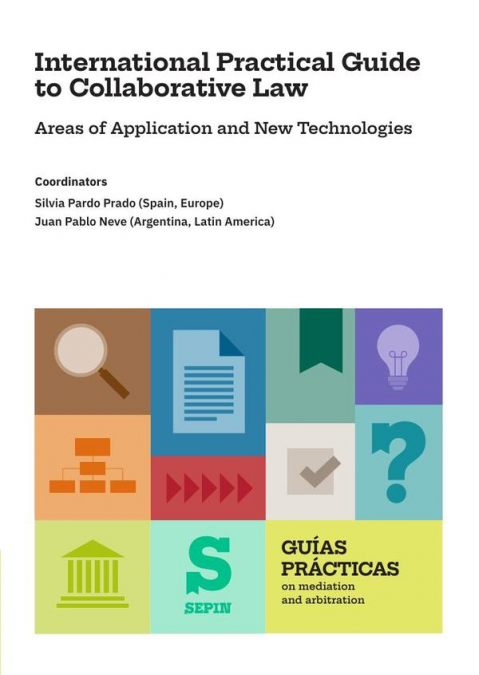
International practical guide to collaborative law

International practical guide to collaborative law

Juan Pablo Neve

46,70 €
IVA incluido
Disponible
Editorial:
Editorial Jurídica Sepín
Año de edición:
2026
Materia
Derecho internacional
ISBN:
9791370418052
46,70 €
IVA incluido
Disponible
Añadir a favoritos

In a legal context marked by judicial overload, the complexity of disputes, and the need for more humane and effective responses, this work serves as an essential reference for understanding and applying Collaborative Law from a practical, contemporary, and international perspective, where attorneys accompany their clients at every step. Furthermore, as legal professionals, we ask ourselves: Where can we apply collaborative law? Is it cross-cutting?This volume, edited by Silvia Pardo Prado and Juan Pablo Neve, brings together a wide range of distinguished jurists and professionals from Spain, Europe, and Latin America, who address these questions and offer a rigorous, cross-cutting perspective on Alternative Dispute Resolution (ADR) and, in particular, on the collaborative process as a genuine alternative to traditional litigation.The book combines theoretical foundations, up-to-date regulatory analysis —with special attention to Organic Law 1/2025—, forms, and clear practical guidance, offering models, real-life cases, and useful tools for professional intervention in fields as diverse as family law, inheritance, consumer law, housing, business, healthcare, labor, sports, civil, commercial, tax, bankruptcy, technology, and public administration.One of the key strengths of this guide is its forward-looking perspective: it addresses the application of Collaborative Law in digital environments, cybersecurity, data protection, technology contracts, as well as the use of new technologies and virtual reality, positioning legal professionals to face current and emerging challenges in legal practice.This work not only explains what Collaborative Law is, but also how, when, and why to use and apply it, making it an essential tool for legal professionals, mediators, and arbitrators, as well as for legal practitioners, educators, and students committed to a more efficient, sustainable, and people-centered justice system.An indispensable guide for those who believe that resolving conflicts can also be an act of responsibility, innovation, and social commitment within their own legal discipline. 10
Artículos relacionados

  • Comparative regulation, economic analysis, and applications of private equity in the united states and european union
    Irini Liakopoulou
    The present work examines the economics and legal doctrine of private equity. After a consideration of private equity’s origins, the book will explore the evolution of private equity in the United States and Europe. The reference economic model then will be reconstructed, with particular attention to financial flows to and from private equity firms and funds. This reconstructio...
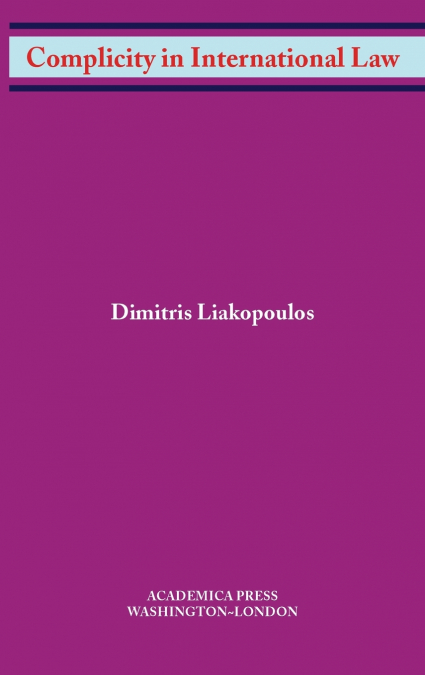
  • Complicity in International Law
    Dimitris Liakopoulous
    Complicity in International Law aims to analyze questions arising from a state’s complicity in conflict with another state or an international organization. On the basis of international legal provisions, a state that assists the illicit fact of another state or an international organization in turn commits an offense if it is aware of the main fact and is bound by the same obl...
  • Command responsibility
    James B Whisker / Kevin R Spiker
    Command responsibility, or executive accountability, assumes that leaders are responsible for the actions of their subordinates. If subordinates misbehave, violate basic moral laws, transgress international law, or thwart international standards of behavior, their leader may be called before to justice. Standards that set the boundaries of human action have been evolving for ma...
  • International Organizations and Reparations
    Dimitris Liakopoulos
    In the first part of this book, noted legal scholar Dimtris Liakopoulos deals with reconstructing the legal regulatory framework governing human rights violations in the activities of organizations. After identifying rules that are generally applicable to organizations’ offenses and govern the profile of reparations, this study assesses primary rules that guarantee the right to...
  • International Organizations and Legal Sanctions Against Governments
    Dimitris Liakopoulos
    This book examines the relationship between governments and international organizations under international law. After surveying the policing powers of international organizations under international law, it illustrates some normative aspects of law that distinguish regulation from enforcement via study of recent legal cases before international judicial bodies. According to Di...
  • The EU Foreign Subsidies Regulation
    Andreas Reindl / Isabelle Van Damme
    'The EU Foreign Subsidies Regulation' is a pioneering manual authored by legal experts Andreas Reindl and Isabelle Van Damme. This essential guide, the first of its kind, is tailored for legal practitioners, offering a thorough exploration of the tools and mechanisms embedded within this novel European regulatory framework. The authors meticulously dissect the EU Foreign Subsid...