Inicio > Matemáticas y ciencia > Ciencia: cuestiones generales > Carl Jung and Wolfgang Pauli. The Entanglement of the Soul
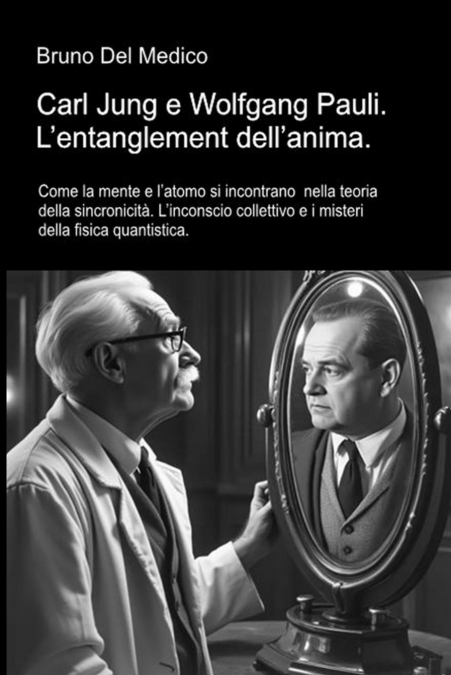
Carl Jung and Wolfgang Pauli. The Entanglement of the Soul

Carl Jung and Wolfgang Pauli. The Entanglement of the Soul

Bruno Del Medico

19,12 €
IVA incluido
Disponible
Editorial:
PensareDiverso-ing
Año de edición:
2026
Materia
Ciencia: cuestiones generales
ISBN:
9788899264444
19,12 €
IVA incluido
Disponible
Añadir a favoritos

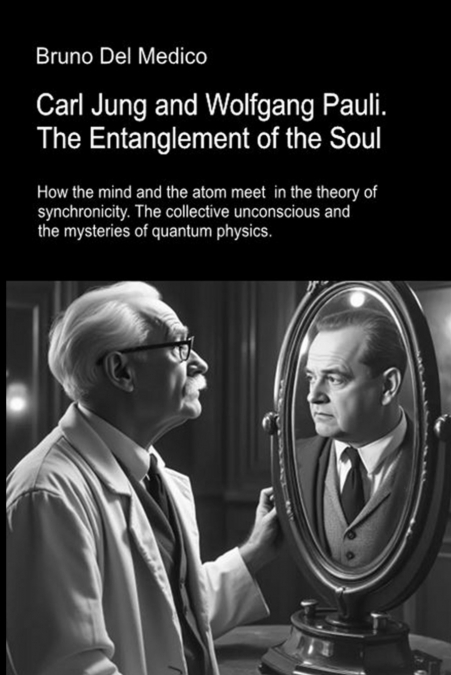
The history of 20th-century European culture offers few encounters as fascinating and unlikely as that between Carl Gustav Jung, Swiss psychiatrist and founder of analytical psychology, and Wolfgang Pauli, Austrian theoretical physicist and one of the fathers of quantum mechanics. Their collaboration, which began in 1932 and lasted for more than twenty years, represents one of the most daring explorations of the borderlands between psychology and physics. This unique collaboration took place during a particularly dramatic period. It began in the 1930s, when Europe was going through a deep crisis: the Great War had just left a heavy legacy of unrest. The next event, World War II, was already foreshadowed by political and cultural upheavals. However, the intellectual climate was one of the most fertile in European history: new ideas were sweeping through physics, philosophy, and psychology. Jung led a group of scholars and therapists in Zurich. He was searching for a depth psychology capable of explaining the great myths, religions, and symbols of humanity. Pauli was also in Zurich, at the Institute of Physics, after contributing in 1925 to the exclusion principle that bears his name. This principle revolutionized atomic physics.Jung was fascinated by science but perceived its limitations, especially in reducing reality to what is quantifiable. Pauli, a man of rigorous science but with a restless spirit, suffered a deep personal crisis after the death of his mother and the failure of his marriage. In 1932, he turned to Jung for psychotherapeutic counseling. This encounter marked the beginning of a surprising dialogue, half therapeutic, half philosophical, known as the ' .' More than 800 letters from this dialogue remain, published years later and now read as a unique historical event.Jung recognized Pauli as an exceptional interlocutor. Pauli was a friend and colleague of Einstein, Bohr, and Heisenberg, and in 1945 she received the Nobel Prize; however, her scientific lucidity did not exclude a sensitivity to the themes of the unconscious, symbolism, and dreams. In fact, Pauli stimulated Jung with his dreams: visions populated by archetypal symbols, mandalas, and alchemical figures. Pauli dreamed of a 'world of shadows' populated by mysterious animals, wheels, and crosses-images that Jung interpreted as signs of the search for a balance between opposites, between scientific rationality and spiritual instinct.This gave rise to the theory of synchronicity, a concept that Jung developed in the 1940s and defined comprehensively for the first time in 1952 in his famous essay written jointly with Pauli: 'Synchronicity as the principle of acausal connections.' Synchronicity describes the 'meaningful coincidence' between psychic events and physical phenomena, events connected not by material causes but by shared meanings. It is a theory that dares to question the dogma of classical causality, the pillar that had supported modern science since Newton.In 1948, in Jung’s famous 'Psychological Club' in Küsnacht, Pauli presented his ideas to an attentive audience: 'There is a level, perhaps, where matter and mind are two sides of the same reality.' It is an idea that anticipates many of today’s debates on neuroscience, the origins of consciousness, and the limits of scientific knowledge.The collaboration between Jung and Pauli left a profound legacy. It inspired scholars such as Marie-Louise von Franz, an analytical psychologist and collaborator of Jung, and physicists such as David Bohm. The collective unconscious, theorized by Jung, and the mysteries of quantum entanglement continue to suggest that the boundaries between mind and matter are less clear-cut than traditional science has wanted to believe.


Artículos relacionados

  • Cases on Research-Based Teaching Methods in Science Education
    Eugene de Silva
    While the great scientists of the past recognized a need for a multidisciplinary approach, today’s schools often treat math and science as subjects separate from the rest. This not only creates a disinterest among students, but also a potential learning gap once students reach college and then graduate into the workforce. Cases on Research-Based Teaching Methods in Science Educ...
    Disponible

    256,29 €

  • Enhancing Qualitative and Mixed Methods Research with Technology
    Shalin Hai-Jew
    In light of the expensive nature of quantitative research, such as experiments, researchers must seek other methods of understanding the world around them. As such, new qualitative methods are gaining ground in the modern research community. Enhancing Qualitative and Mixed Methods Research with Technology explores the integration of new digital tools into the research process. ...
    Disponible

    296,26 €

  • Emerging Research on Bioinspired Materials Engineering
    Mohamed Bououdina
    Bioinspired materials can be defined as the organic or inorganic materials that mimic naturally occurring substances. With applications in a number of fields such as biomedical, chemical, mechanical, and civil engineering, research on the development of biologically-inspired materials is essential to further advancement. Emerging Research on Bioinspired Materials Engineering pr...
    Disponible

    282,43 €

  • Contemporary Knowledge and Systems Science
    As branches of research and knowledge continue to expand, platforms for gathering and understanding new information become important aspects of organizational improvement. Contemporary Knowledge and Systems Science provides emerging research on the methods and applications of knowledge systems in social science, economics, and technological developments. While highlighting topi...
    Disponible

    242,89 €

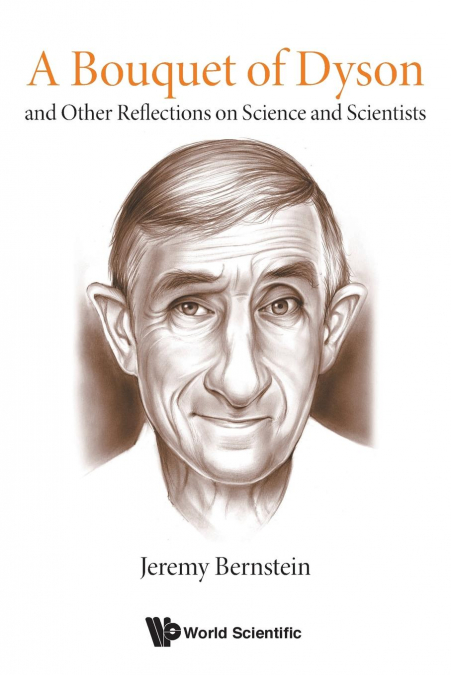
  • BOUQUET OF DYSON, A
    BERNSTEIN JEREMY / Jeremy Bernstein
    University of Texas at Austin My friendship with Freeman Dyson goes back over a half century. My first contact with him goes back to the late 1950s, when I was at the Institute for Advanced Study, and then evolved when I was a consultant at General Atomics in La Jolla, California. Freeman was then trying to design a space ship — the Orion — which would be propelled by atomic bo...
    Disponible

    33,35 €

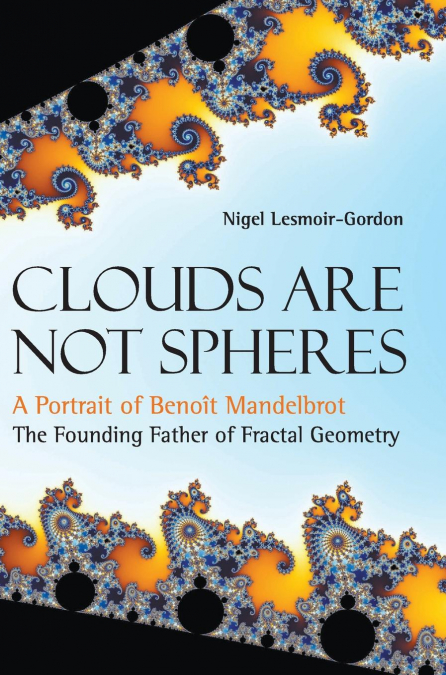
  • CLOUDS ARE NOT SPHERES
    LESMOIR-GORDON NIGEL / NIGEL LESMOIR-GORDON
     The time is right, following Benoît Mandelbrot's death in 2010, to publish this landmark book about the life and work of this maverick math genius.This compact book celebrates the life and achievements of Benoît Mandelbrot with the ideas of fractals presented in a way that can be understood by the interested lay-person. Mathematics is largely avoided. Instead, Mandelbrot&#...
    Disponible

    70,98 €

Otros libros del autor

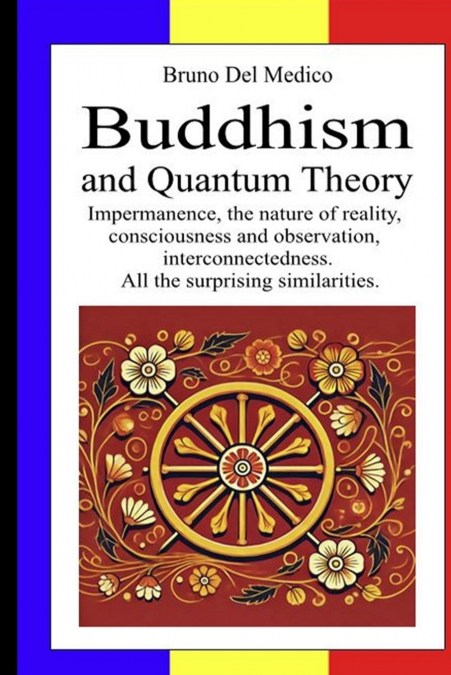
  • Buddhism and Quantum Theory
    Bruno Del Medico
    In the landscape of human knowledge, the boundaries between science and philosophy are proving increasingly permeable, giving rise to unexpected dialogues between seemingly distant worlds. In this book, we aim to explore the fascinating intersection between Eastern philosophies, with a particular focus on Buddhism, and modern discoveries in quantum physics. The goal is clear: t...
    Disponible

    12,60 €

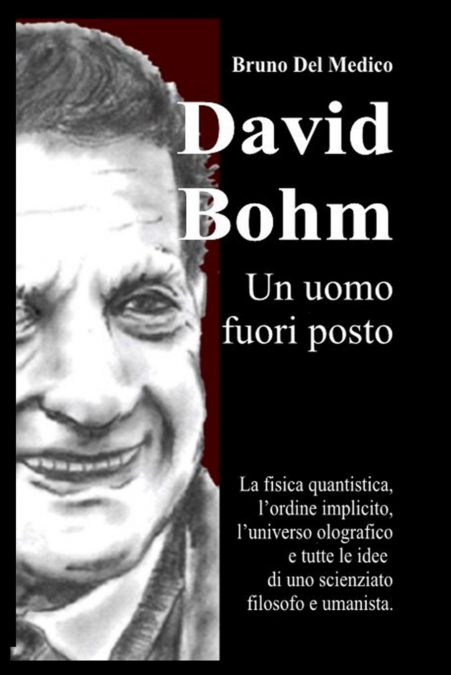
  • David Bohm. Un uomo fuori posto
    Bruno Del Medico
    Nel panorama della fisica e della filosofia del XX secolo, David Bohm emerge come una figura di spicco, capace di attraversare le frontiere tra scienza e spiritualità. Le sue idee sull’ordine implicito e l’olografia non solo hanno influenzato il campo della fisica quantistica, ma hanno anche aperto nuove strade al pensiero filosofico contemporaneo. Bohm nacque nel 1917 a Wilkes...
    Disponible

    23,14 €

  • David Bohm. Um homem fora do lugar
    Bruno Del Medico
    No panorama da física e da filosofia do século XX, David Bohm surge como uma figura de primeiro plano, capaz de ultrapassar as fronteiras entre a ciência e a espiritualidade. As suas ideias sobre a ordem implícita e a holografia não só influenciaram o campo da física quântica, como também abriram novas vias para o pensamento filosófico contemporâneo. Bohm nasceu em 1917 em Wilk...
    Disponible

    23,11 €

  • David Bohm. Wetenschapper, filosoof, humanist
    Bruno Del Medico
    In het panorama van de 20e-eeuwse natuurkunde en filosofie komt David Bohm naar voren als een leidende figuur die in staat is de grenzen tussen wetenschap en spiritualiteit te overschrijden. Zijn ideeën over impliciete orde en holografie beïnvloedden niet alleen het gebied van de kwantumfysica, maar openden ook nieuwe wegen voor het hedendaagse filosofische denken. Bohm werd in...
    Disponible

    23,02 €

  • David Bohm. A Man Out of Place
    Bruno Del Medico
    In the landscape of 20th-century physics and philosophy, David Bohm emerges as a prominent figure, capable of crossing the frontiers between science and spirituality. His ideas on implicit order and holography not only influenced the field of quantum physics, but also opened new avenues for contemporary philosophical thought. Bohm was born in 1917 in Wilkes-Barre, Pennsylvania,...
    Disponible

    27,85 €

  • Carl Jung e Wolfgang Pauli. O entrelaçamento da alma
    Bruno Del Medico
    A história da cultura europeia do século XX oferece poucos encontros tão fascinantes e improváveis quanto o entre Carl Gustav Jung, psiquiatra suíço e fundador da psicologia analítica, e Wolfgang Pauli, físico teórico austríaco, um dos pais da mecânica quântica. A sua colaboração, iniciada em 1932 e que durou mais de vinte anos, representa uma das explorações mais ousadas dos t...
    Disponible

    19,08 €