Building the Judiciary

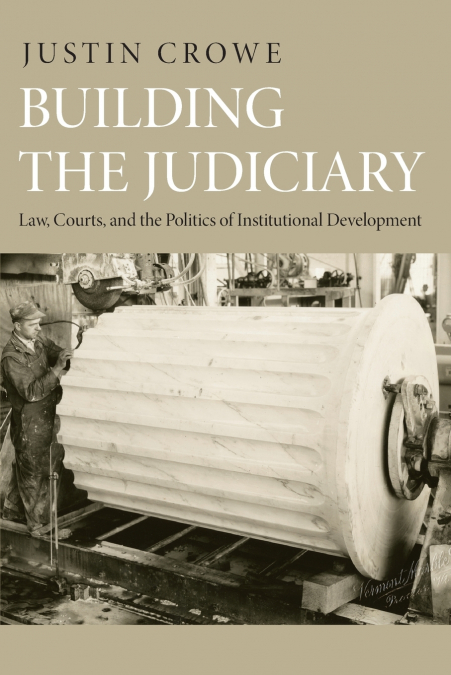
Building the Judiciary

Justin Crowe

67,94 €
IVA incluido
Disponible
Editorial:
Princeton University Press
Año de edición:
2012
Materia
Historia del derecho
ISBN:
9780691152936
67,94 €
IVA incluido
Disponible
Añadir a favoritos

How did the federal judiciary transcend early limitations to become a powerful institution of American governance? How did the Supreme Court move from political irrelevance to political centrality? Building the Judiciary uncovers the causes and consequences of judicial institution-building in the United States from the commencement of the new government in 1789 through the close of the twentieth century. Explaining why and how the federal judiciary became an independent, autonomous, and powerful political institution, Justin Crowe moves away from the notion that the judiciary is exceptional in the scheme of American politics, illustrating instead how it is subject to the same architectonic politics as other political institutions. Arguing that judicial institution-building is fundamentally based on a series of contested questions regarding institutional design and delegation, Crowe develops a theory to explain why political actors seek to build the judiciary and the conditions under which they are successful. He both demonstrates how the motivations of institution-builders ranged from substantive policy to partisan and electoral politics to judicial performance, and details how reform was often provoked by substantial changes in the political universe or transformational entrepreneurship by political leaders. Embedding case studies of landmark institution-building episodes within a contextual understanding of each era under consideration, Crowe presents a historically rich narrative that offers analytically grounded explanations for why judicial institution-building was pursued, how it was accomplished, and what--in the broader scheme of American constitutional democracy--it achieved.
Artículos relacionados

  • The Constrained Court
    Forrest Maltzman / Michael A. Bailey
    How do Supreme Court justices decide their cases? Do they follow their policy preferences? Or are they constrained by the law and by other political actors? The Constrained Court combines new theoretical insights and extensive data analysis to show that law and politics together shape the behavior of justices on the Supreme Court. Michael Bailey and Forrest Maltzman show how t...
    Disponible

    47,52 €

  • Emma Goldman’s No-Conscription League and the First Amendment
    Erika Pribanic-Smith / Jared Schroeder
    In this short book, Schroeder and Pribanic-Smith analyze the communications that led to Goldman’s arrest--writings in Mother Earth, a mass-mailed manifesto, and speeches related to compulsory military service during World War I. ...
    Disponible

    42,66 €

  • Emma Goldman’s No-Conscription League and the First Amendment
    Erika J. Pribanic-Smith / Erika Pribanic-Smith / Jared Schroeder
    In this short book, Schroeder and Pribanic-Smith analyze the communications that led to Goldman’s arrest--writings in Mother Earth, a mass-mailed manifesto, and speeches related to compulsory military service during World War I. ...
    Disponible

    106,23 €

  • Judicial Independence in China
    Randall Peerenboom
    ...
    Disponible

    51,64 €

  • Decision Making by the Modern Supreme Court
    Brett W. Curry / Brett WCurry / Bryan W. Marshall / Bryan WMarshall / Richard L. Jr. Pacelle / Richard LJrPacelle
    ...
    Disponible

    44,40 €

  • Civil Liberties and the Constitution
    Kevin Lyles / Lucius Barker / Michael Combs
    Updated in a new 9th edition, this casebook explores civil liberty problems through a study of leading judicial decisions. It offers a reasonable sample of cases across a broad spectrum of rights and liberties. This book introduces groups of featured cases with in-depth commentaries that set the specific historical-legal context of which they are a part, allowing readers to exa...
    Disponible

    577,62 €